

Contents
In international trade, cargo is rarely held because of the goods themselves. It is held because the paperwork describing them disagrees. One wording difference between the invoice and packing list, one HS code mismatch between the declaration and the C/O, is enough to stop a filing for explanation. The checklist below is the internal review Homexim's documentation team runs, with the role and the usual failure point of each document.
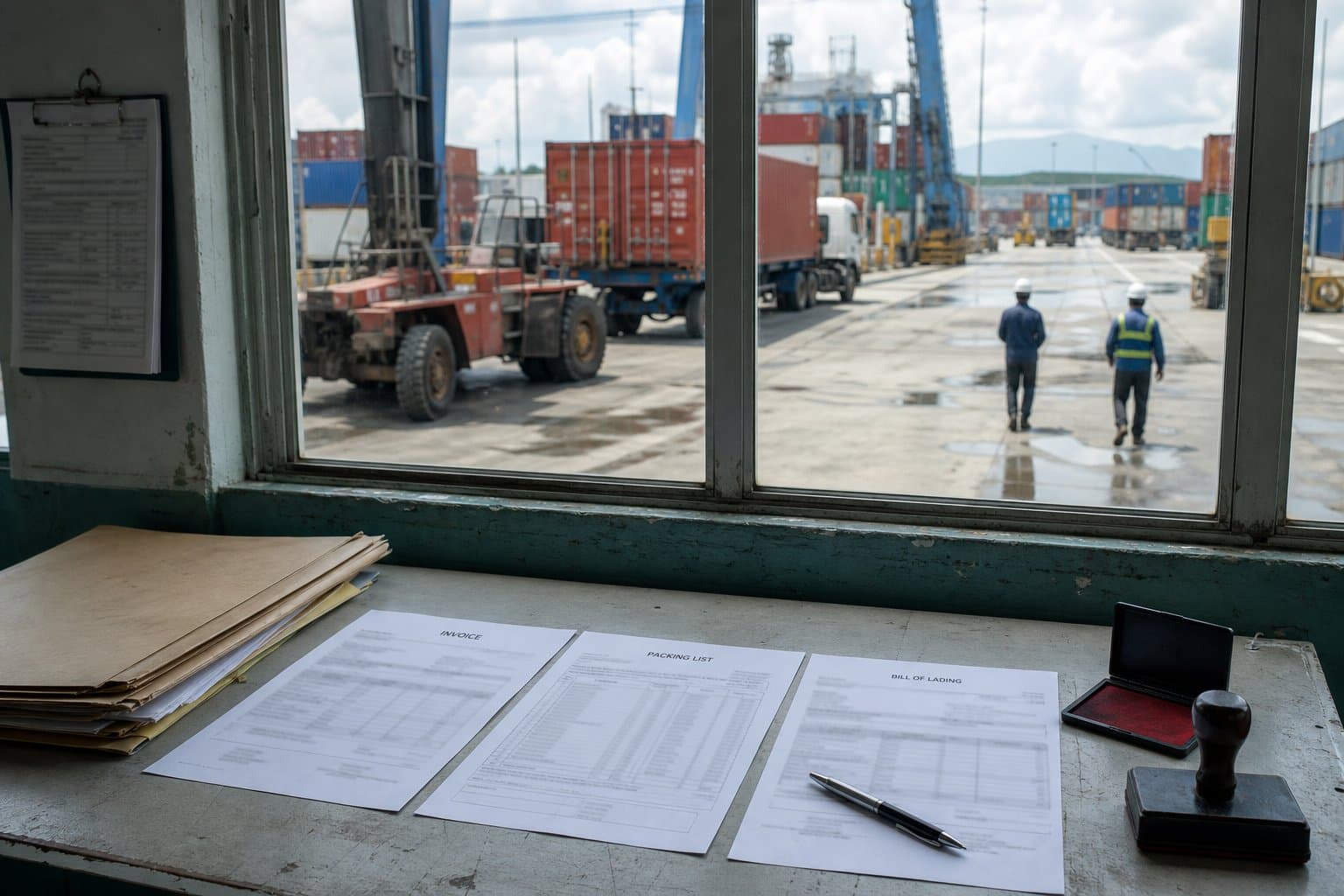
The core document set for a standard export
A standard ocean export needs five core documents: the contract or PO, the commercial invoice, the packing list, the booking confirmation, and the bill of lading. Add a C/O when preferential duty is claimed, and a specialized permit when the goods are regulated. This is the minimum you should have in hand before filing the declaration.
- Contract or PO: the basis for price and delivery terms (Incoterms).
- Commercial Invoice: value, unit prices, payment terms; must match the contract.
- Packing List: package count, net and gross weight, packing specs; must match the invoice line by line.
- Booking confirmation: container number, closing time, origin and destination ports.
- Bill of Lading (draft first, original or telex later): shipper, consignee, notify party details.
- C/O when the buyer claims preferential duty (form per the relevant FTA).
- Specialized permits where applicable: quarantine, fumigation, conformity declarations.
What each document does, and where it usually breaks
The commercial invoice is the value document: customs uses it to set the dutiable value, and the bank uses it to release payment. It usually breaks when the unit price or the Incoterms term on the invoice does not match the contract, or when the goods carry a short trade name while the declaration uses a technical one. A value that sits well below customs reference data also invites a valuation query.
The packing list is the physical map of the shipment: how many packages, net and gross weight, packing format. Container inspectors and examination officers read it against what is actually in the box. The classic error is a packing-list weight that disagrees with the VGM filed to the carrier, or package counts that do not add up to the invoice total.
The bill of lading (ocean) or air waybill (air) is both the transport contract and the document of receipt at destination. With an original B/L, whoever holds the original controls delivery, so a wrong consignee or notify party is a serious error. Plenty of shipments stall at destination because a draft B/L was approved in a hurry, and the misspelled consignee name only surfaced once the original was issued, forcing an amendment and its fee.
The customs declaration is the shipper's statement to the customs authority, filed through the VNACCS system. Every field on it must trace back to a source document: goods name, HS code, value, origin. Correcting a key field after clearance means a supplementary declaration, which costs time and flags your later shipments for closer attention.
The C/O (certificate of origin) decides whether the buyer at destination gets a duty reduction under a trade agreement. Each FTA uses its own form: Form E for the ASEAN and China agreement (ACFTA), EUR.1 for the Vietnam and EU agreement (EVFTA), Form D within ASEAN. It usually breaks when the goods description or HS code on the C/O differs from the export declaration, which makes destination customs doubt it and refuse the preference. A rejected C/O means the buyer pays the full standard rate, enough to lose the customer.
Situational documents: start early or miss the vessel
Beyond the core set, some shipments need extra documents depending on the goods and the payment method. All of them take time, so identify them the moment the booking exists rather than near closing time.
- Preferential C/O: applied for at the issuing body (VCCI or the Ministry of Industry and Trade depending on the form), backed by origin evidence, so prepare it several days ahead.
- Permits and specialized inspection: plant or animal quarantine, fumigation, quality checks, conformity declarations depending on the product (specialized inspection).
- L/C document set: when paying by letter of credit, every document must match the L/C terms word for word, because a bank discrepancy delays payment.
Why the HS code and goods description must run through every document
The HS code and goods description are the thread that ties the whole file together. For one shipment, the HS code and the way the goods are named must be identical on the invoice, packing list, declaration, and C/O. A mismatch carries two consequences: the HS code drives the duty rate and whether the goods fall under specialized management, while the description is what customs uses to route the declaration and inspect the cargo. Declaring one HS code to dodge a permit or claim a lower duty, then being reclassified at examination, ends in both back-duty and a penalty.
For one shipment, the HS code and goods name must be identical on the invoice, packing list, declaration, and C/O.
Five consistency checks that are non-negotiable
- Goods description: invoice, packing list, B/L, and declaration must name the goods identically.
- Quantity and weight: a packing list versus VGM or B/L mismatch is the most common reason cargo stops.
- HS code: consistent across the declaration and C/O, since a mismatch risks C/O rejection at destination.
- Party names and addresses: shipper and consignee on the B/L must match the contract, and the L/C if paying by letter of credit.
- Incoterms: the invoice value must reflect the term (FOB excludes freight; CIF includes freight and insurance).
When to prepare: earlier than you think
Many shippers start on documents after the cargo is packed, too late if the shipment needs a C/O or specialized inspection, since those take days to a week. Homexim's rule: lock the document list the moment the booking exists, and have a complete draft set at least 48 hours before closing time.
A clean file set does more than speed up clearance. It is your insurance in a post-clearance audit. Under Vietnam's 2014 Customs Law, the declarant must keep the customs dossier for five years from the date the declaration is registered, so the original set for every shipment must be complete and retrievable on request. Archiving the full original set per shipment is something Homexim does for customers by default.
Related service: Customs brokerage