
Contents
Decree 384/2026/NĐ-CP sets rules for determining Vietnamese origin of goods made and sold in the domestic market, effective 1 January 2027. Standing Deputy Prime Minister Phạm Gia Túc signed it on behalf of the Government on 9 October 2026. The decree has 12 articles.
Until now, origin rules mainly served exports, imports and tariff preferences. The Import-Export Department says the new decree closes a legal gap and targets origin fraud and misleading labels on the domestic market.
Two categories of goods, two tests
Article 5 covers wholly obtained goods. Article 6 covers goods that are not wholly obtained, meaning products made with imported inputs or inputs of unclear origin.
For the second group, companies pick one of two criteria. The first is a change in tariff classification at the 4-digit level. The second is a Vietnam value content (VVC) of at least 30% of the ex-works price.
For IT and digital-technology goods, certain costs count toward VVC if they are tied to the production process: R&D, design, programming, digitalization, automation, technical testing and software testing (clause 4, Article 6). Packaging is treated as part of the goods, so its value counts toward VVC too. Companies choose the direct or indirect formula and apply it for the whole financial year.
Simple operations do not confer origin
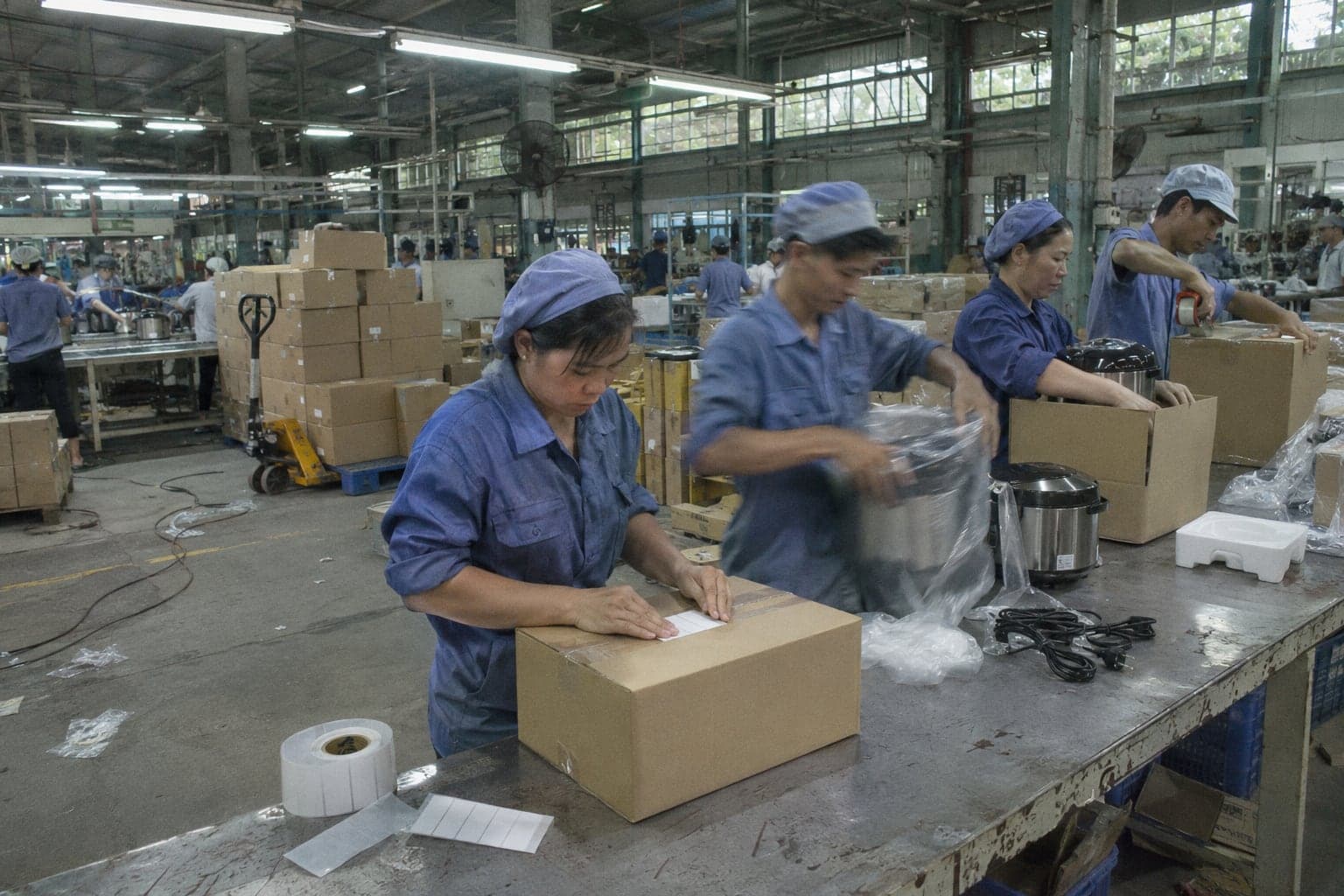
Article 7 excludes a set of operations from the basis for Vietnamese origin: simple processing, preservation, simple packing, labeling, splitting shipments, stamping and crude assembly. Goods that go through only these steps do not become Vietnamese goods under the decree.
Self-determination, self-responsibility
No certificate of origin is issued for goods made and sold domestically. Determining origin is voluntary and free of charge.
Companies determine and declare origin themselves and answer for the accuracy of what they declare. The file must include input invoices, a bill of materials and a description of the production process, ready to be produced when authorities ask. Regulators inspect and run post-checks on the basis of this file.
Article 12 is the transitional clause. Goods that already carried a compliant Vietnamese origin label before the effective date may keep using it until expiry. Goods in circulation before 1 January 2027 do not need to be relabeled.
Impact by type of operation
The published source does not name specific sectors, so the impact below is split by type of operation.
Goods made from imported inputs or inputs of unclear origin are hit hardest. Companies must choose between the 4-digit tariff change and the 30% VVC test, and lock in a VVC formula for the full financial year.
Contract-processed, packed and split-lot goods sit right at the edge of Article 7. If the main operation is only simple packing, splitting shipments or stamping, the goods lack a basis for a Vietnamese origin claim.
Digital technology products gain from clause 4, Article 6, because R&D, design, programming and software testing costs count toward VVC. The condition is that these costs are tied to the process that creates the product and backed by documents.
What it means for cargo owners
The decree applies to goods sold in Vietnam. It is not a rule on export C/O and does not change how C/O applications are filed.
Still, the file it requires (tariff change, 30% VVC, input invoices, bill of materials) overlaps with what exporters keep: input invoices and the bill of materials also back an export C/O, although each FTA sets its own origin criteria. For preferential export C/O, see our piece on the CPTPP C/O utilization rate.
Goods made in Vietnam and then exported remain subject to Vietnamese law on export origin and to the importing country's rules. Origin under Decree 384 does not replace either layer.
What exporters should do
Build origin files before 1 January 2027 around one set of documents: input invoices, bill of materials, production process description and a VVC worksheet.
Review contract-processed, packed and split-lot shipments. For each product line, check whether the main operation falls on the Article 7 list of simple operations.
Ask suppliers for complete input invoices and bills of materials. Without both, the VVC worksheet has no support in a post-check.
Fix the VVC formula (direct or indirect) for the financial year and apply it consistently. For goods that already carried a compliant label before 1 January 2027, check Article 12 before deciding whether to relabel.
Sources
Related service: Customs Brokerage