

Contents
Vietnam rewrites its customs classification rulebook on September 15, when Circular 85/2026/TT-BTC replaces both Circular 14/2015 and Circular 17/2021. The Ministry of Finance signed it on June 30. The circular simplifies registration and sampling while requiring technical documents where customs lacks sufficient data in its system. If documents are unavailable, the reason must be stated. The new rules apply from September 15, 2026.
What changes in HS classification for Vietnam trade
The core principle survives: one product carries one code under Vietnam's export and import tariff nomenclature. What moves is the order of authority behind that code. The circular sets the reference chain as the HS explanatory notes, the WCO compendium of classification opinions and the AHTN notes; where descriptions diverge between nomenclatures, the HS and AHTN wording prevails under treaty principle. For unassembled or disassembled machinery, a practical preparation step is to document the configuration and how the components relate to one another, rather than proposing a code from the trade name alone.
Read the scope clause closely. The new circular pulls the use of analysis results for quality control and food safety inspection out of its own remit, leaving classification as the single purpose. In exchange, standards and technical regulations issued by competent authorities can now be used to establish a product's name and description.
Three formalities that get lighter
Combined machinery and machine assemblies gain the most.
- Combined machinery or machine assemblies under Chapters 84, 85 and 90 imported in a single consignment no longer need a registered product list or a drawdown monitoring sheet.
- Where the equipment arrives across several shipments, the product list is registered before the import declaration of the first consignment, rather than before the first importation as the old rule required.
- If the declarant is absent at sampling, one witness now suffices, whether the port operator, a state agency present in the area or a carrier representative, instead of all parties attending.
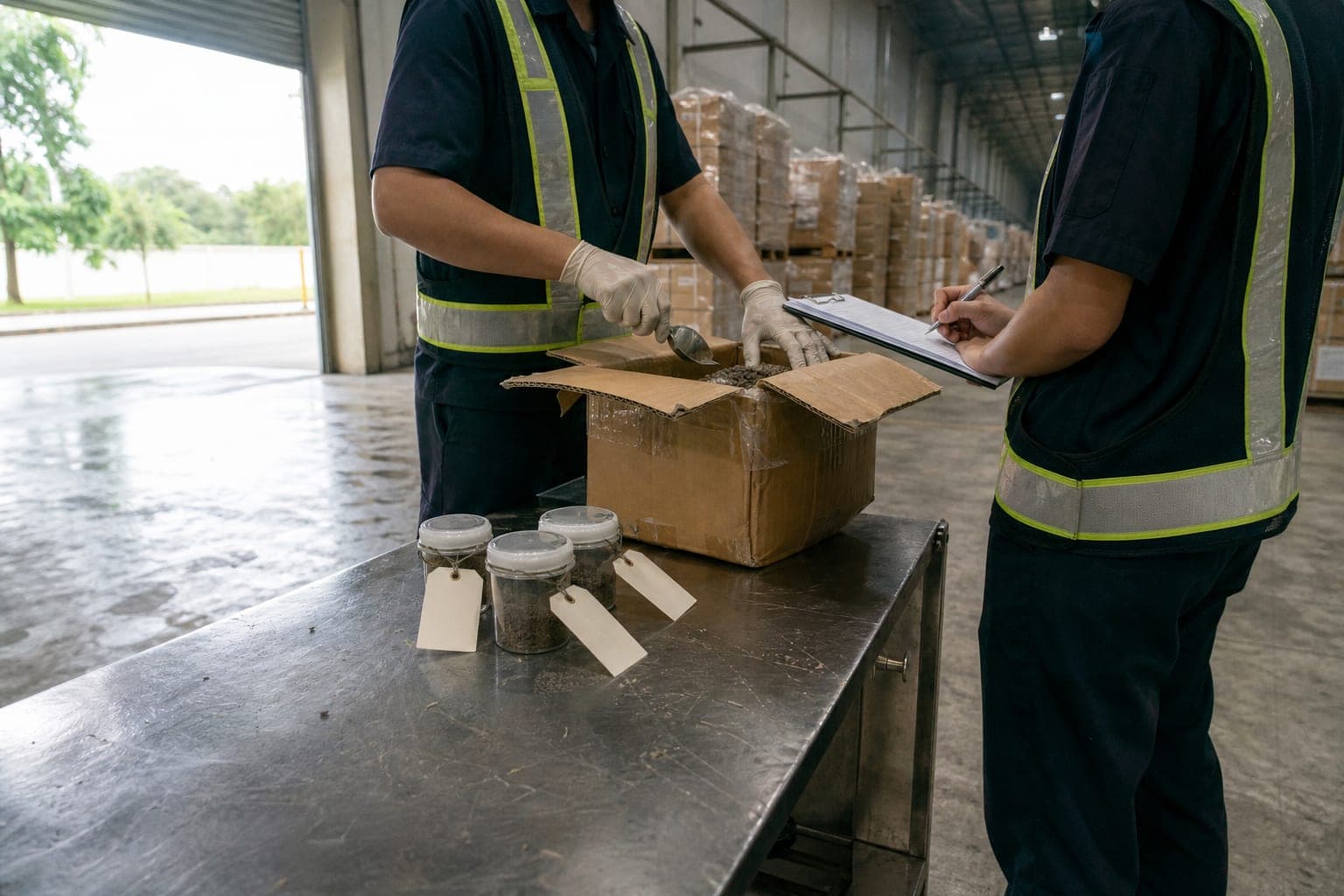
Turnaround is written into the text as a number. Customs issues the analysis and classification result within five working days for ordinary goods and within 20 working days for complex ones. Two representative samples are drawn per consignment and sealed separately. If the declarant disagrees with the result, samples are retained for 120 days from the notification date and continue to be held until a decision on the complaint is issued. This is a sample-retention period, not an appeal deadline.
When are technical documents required?
Technical documents are required where customs does not have sufficient data in its system. If documents are unavailable, the reason must be explained. Relevant records may cover characteristics, composition, construction, intended use or the manufacturing process. In practical terms, classification involves more than selecting a code: technical data, product records and laboratory findings also need to be considered.
Classification stops being the act of picking the right string of digits and becomes an assessment built on technical data, product records and laboratory findings.
The burden lands unevenly. Those affected run from established traders and SMEs to household businesses, cross-border e-commerce startups and logistics companies. The smallest operators are precisely the ones least likely to hold standardised technical files, while a wrong code drives both the duty rate and the product policy applied at the border.
Impact by commodity
Machinery, equipment and production lines take the clearest gain. Dropping the product list and drawdown sheet for single-consignment shipments removes a full registration round before the vessel berths. For lines split across sailings, the registration deadline shifts to the first import declaration, which gives the buyer room to finalise machine configuration before filing. Work already under way keeps its current footing: complex machinery in Chapters 84, 85 and 90 with a registered product list continues under Circular 14/2015 until the declared volume is fully imported.
For goods requiring analysis to establish a code, Homexim recommends reviewing composition and manufacturing records when placing the order. This is preparation advice, not a list of commodities automatically subject to analysis. Documents are required where customs lacks sufficient system data; if they are unavailable, the reason must be explained. Food importers should also read the scope carefully: this circular no longer regulates the use of analysis results for quality control and food safety inspection. That does not establish a blanket prohibition on using those results under other applicable rules.
Practical checks under the rules effective September 15, 2026
As a practical check, review the code alongside the duty rate and product policy; do not treat it as the sole determinant of physical inspection. Compare the analysis timeline with your actual free time to assess potential demurrage and detention exposure. Preparing records when placing the order may reduce requests for additional documents, but does not guarantee faster processing. Ask suppliers before cargo arrives rather than waiting until customs draws a sample.
- Screen the products that routinely go for analysis and ask suppliers up front for characteristics, composition, construction, intended use and manufacturing process.
- Production lines still arriving against an old registered list: keep the file under Circular 14/2015 until the volume is exhausted rather than switching mid-project.
- Machine assemblies imported across several shipments and subject to list registration under the rules effective September 15, 2026: register before the first consignment's declaration.
- Food cargo: review quality control, food safety and classification documentation requirements separately; do not assume one result satisfies every procedure.
- If you disagree with a result, note the 120-day retention period from notification and continued retention until the complaint decision. Do not treat that period as an appeal deadline.
Homexim handles customs clearance on both import and export legs, including building the classification file before the declaration is channel-assigned and reviewing specialised inspection requirements separately from classification records. You can send your import product list to discuss which items may need analysis and what documentation to prepare under the rules effective September 15, 2026.
Sources
- Tạp chí Kinh tế Tài chính: Đổi mới quy định phân loại, phân tích hàng hóa xuất nhập khẩu
- Báo Pháp Luật Việt Nam: Từ ngày 15/9, đơn giản hóa nhiều thủ tục phân loại hàng hóa xuất nhập khẩu
- LuatVietnam: Thông tư 85/2026/TT-BTC quy định phân loại hàng hóa xuất nhập khẩu
- Doanh nghiệp & Hội nhập: Thông tư mới gỡ vướng phân loại hàng hóa xuất nhập khẩu từ ngày 15/9
- Doanh nghiệp & Hội nhập: Phân loại hàng hóa không còn chỉ là xác định mã HS
Related service: Customs brokerage