

Contents
Vietnam's fruit and vegetable exports reached an estimated $1.06 billion in July 2026, up 38% year on year and the first time the sector has cleared $1 billion in a single month, according to preliminary calculations by the Vietnam Fruit and Vegetable Association based on customs data. Durian did the heavy lifting: farm-gate prices rebounded after a long slide, Chinese buyers returned to the market, and a new same-day customs clearance regime for farm produce kicked in mid-July. For shippers, the number signals a second half where volume and prices run together, and reefer slots will not wait.
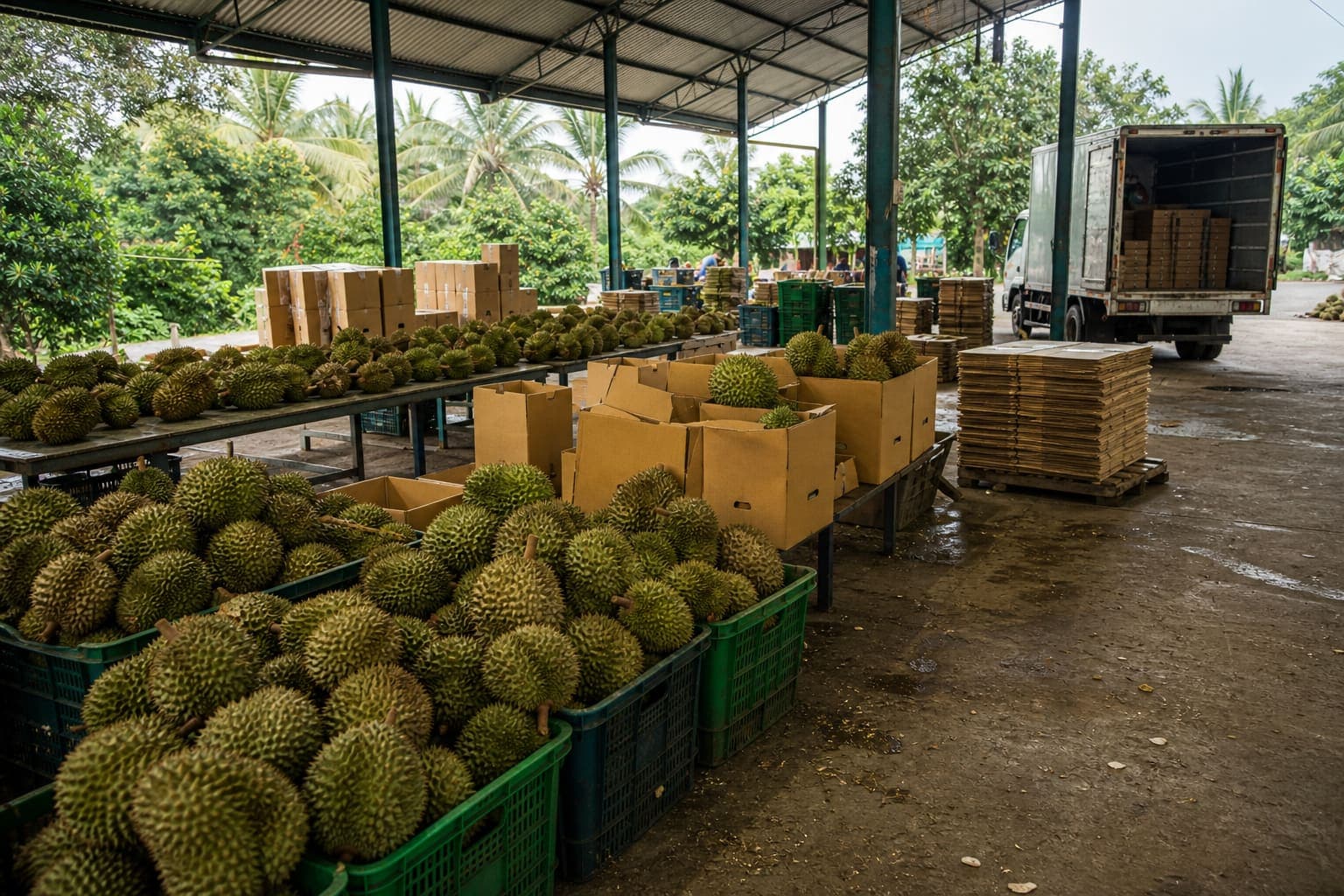
Seven-month exports estimated at $4.76 billion
Cumulative exports for the first seven months are estimated at $4.76 billion, up 23% from the same period of 2025. Imports rose 27% to $1.84 billion, leaving the sector with a trade surplus of nearly $2.92 billion. July stands as the highest-value export month on record.
July 2026 fruit and vegetable exports reached an estimated $1.06 billion, up 38% year on year and the first billion-dollar month on record.
Durian remains the sector's biggest growth engine, contributing more than half of total fruit and vegetable export value, according to Dang Phuc Nguyen, general secretary of the Vietnam Fruit and Vegetable Association. He also points to an upside buried in the earlier price slump: cheap raw fruit gives processors room to scale up frozen durian output for export. The industry's second half, in short, will move with the durian crop and Chinese demand.
Durian prices rebound as China buys again
Farm-gate durian prices climbed 5,000 to 7,000 dong per kilogram over the past week, roughly 8%. Grade A Monthong now fetches 73,000 to 80,000 dong per kilogram depending on the region, while grade A Ri6 sits at 55,000 to 58,000 dong. The pull comes from traders gathering fruit for orders to China, which takes more than 50% of Vietnam's fruit and vegetable export value, alongside the United States, South Korea, Japan and the Netherlands.
Policy is helping too. Vietnam Customs has ordered same-day clearance for agricultural exports, including outside office hours, on weekends and holidays, while ministries speed up the issuance of growing-area codes. Fresh cargo spending less time at the border keeps quality intact on arrival, and that confidence is part of why farm-gate prices dared to move up.
Impact by commodity
Durian gets all three tailwinds at once: recovering prices, stronger Chinese buying and same-day clearance. Notably, frozen durian is contributing an ever larger share of export value. For shippers the two product lines run on different tracks: fresh fruit races the clock through land border gates, while frozen durian moves in reefer containers by sea, tied to sailing schedules and slot availability. As the whole sector accelerates, reefer space and cold equipment will tighten first, so frozen-cargo shippers should forecast volumes to carriers early rather than booking last minute.
Fruit lines bound for the US, South Korea, Japan and the Netherlands lack durian's price surge but ride the sector's 23% growth. These are long ocean lanes with country-specific quarantine and irradiation requirements, so the deciding factor is documentation and cold-chain discipline rather than freight rates. A shipment packed to spec from the start keeps a steady rotation into these demanding markets.
What fruit shippers should line up for the second half
Volume growing 38% year on year means cold-chain capacity and vessel space get claimed early. Work through the list in this order.
- Frozen cargo by sea: forecast volumes and lock in reefer slots with carriers early, especially for the peak weeks of late Q3.
- Fresh cargo by land border: have quarantine papers, growing-area codes and packing-house codes ready before the truck leaves, so the load can use the same-day clearance window.
- Check each destination's import conditions before confirming orders; China, the US and Japan each apply their own quarantine standards.
- Track farm-gate prices when signing forward contracts: prices moved 8% in a single week, and margins shift fast within a season.
Homexim handles customs clearance for agricultural exports, fresh and frozen alike, and has summarized the same-day clearance regime shippers should be using this season. Send your commodity and target market, and the documentation desk will review the quarantine file and advise on reefer options before your cargo hits the peak.
Sources
Related service: Customs brokerage