

Contents
Vietnam's Ministry of Industry and Trade signed Decision 2174/QD-BCT on 7 September, imposing definitive anti-dumping duties of 5.55% to 45.30% on ceramic and porcelain tiles originating in India. The order takes effect 15 days after signature, on 22 September 2026, and runs for five years unless extended, amended or revoked. Case AD23 was opened on 18 August 2025, so the file has sat with investigators for just over a year. Their finding has three limbs: dumping occurred, it threatens material injury to domestic producers, and the two are causally linked.
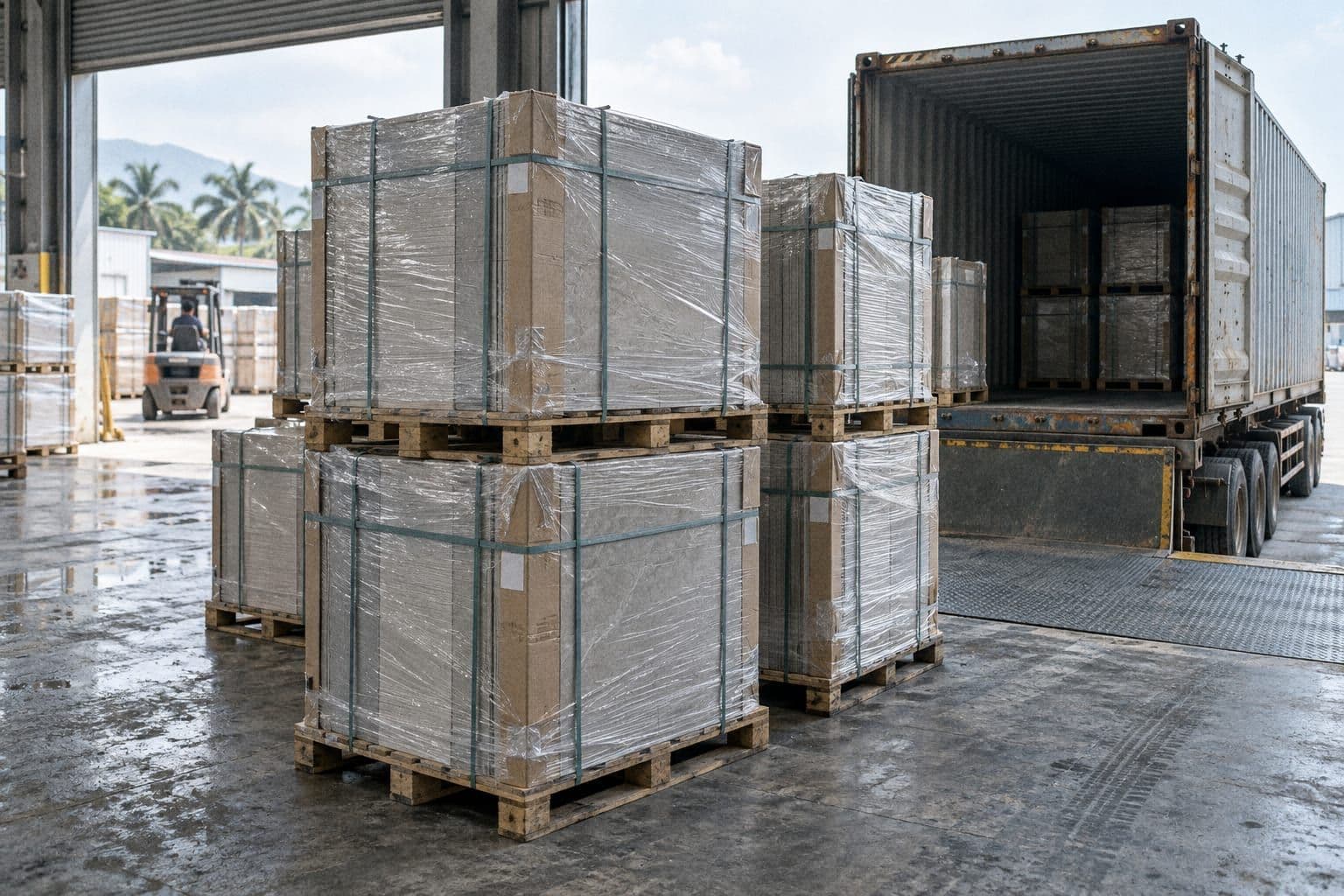
Eight HS codes carry the anti-dumping duty
The scope is eight tariff lines: 6907.21.21, 6907.21.22, 6907.21.23, 6907.21.24, 6907.21.91, 6907.21.92, 6907.21.93 and 6907.21.94. They cover wall tiles, floor tiles and similar products with water absorption of no more than 0.5% by weight, heading 69.04 excluded, which is the porcelain grade that fills most showroom floors. As a practical check, compare the product description with the eight HS codes in the Notice rather than relying solely on the supplier's invoice classification. Any proposed code change should be supported by the product's actual characteristics.
Four rates, three documents
The duty is company-specific. Indian producers selected for sampling received 22.27%, 5.55% or 45.30% according to the list annexed to the decision. Producers outside the sample that cooperated and answered the questionnaire take rates from a separate list, 18.29% among them. Every other Indian producer and exporter pays the ceiling of 45.30%.
Customs fixes the rate for each consignment in three steps. First, proof of origin, either a certificate of origin or an origin self-certification under the relevant trade agreements: no document means 45.30% on the spot, while documented origin in a country or territory other than India means the duty does not apply at all. Second, the manufacturer's certificate: a missing certificate, a name absent from the list or a document that differs from the registered sample all drop the shipment to 45.30%. Third, customs checks the sales contract and commercial invoice: the exporter must match Column 1 of Section 3 or the corresponding exporter in Column 2 on the same row as the manufacturer in the Notice. A valid match receives the corresponding rate; otherwise, 45.30% applies.
No proof of origin means 45.30% on the spot.
For goods within the measure's scope, you need to check the manufacturer, exporter and supporting documents, not just the HS code. When buying through an Indian trading house, a practical precaution is to confirm the producing plant and obtain its certificate in the registered format before filing. Under Section 3 of the Notice, the manufacturer must match Column 1; the exporter on the contract and invoice must match Column 1 or the corresponding entry in Column 2 on the same row. Valid documents establish eligibility for that producer-exporter pair's rate, not automatically 5.55%. Missing or non-matching documents trigger 45.30% under the stated conditions.
Impact by commodity
The domestic tile industry brought the case. Nine producers filed the petition on 2 July 2025: VITTO, A My, Thang Cuong, Thien Hoang, Viglacera Tien Son, TASA, Prime Tien Phong, CTH and HERA, standing for the domestic industry.
Their petition, as reported by Bao Dau Tu, charts the Indian run-up over the investigation period: import volume rose 3.5 times and value climbed from USD 22 million to USD 62 million. The latest period reached almost 11.5 million square metres worth more than USD 73 million, up 14% by volume and 18% by value on the period before. The import unit price fell a cumulative 13%, from above VND 180,000 per square metre in 2021-2022 to VND 159,000 in 2024-2025. In large-format tiles, domestic selling prices reversed and fell a sharp 20%. Domestic producers' market share slid from 86.5% to 81.4% and then to 80.6%.
These figures provide context for the threat-of-injury finding. Bao Dau Tu reports Indian production capacity above 2.9 billion square metres a year. The Vietnam Building Ceramics Association forecasts that imports could reach USD 100 million in the near future without a measure. That is an industry forecast, not recorded import value. Production capacity alone should not be read as a prediction of the volume that will actually be exported to Vietnam.
On the buying side, the duty lands on building materials distributors, contractors and showrooms that use Indian porcelain as their price-competitive range. For illustration, assume a dutiable value of VND 159,000 per square metre, matching the import unit price cited in the petition. Multiplying by 45.30% gives about VND 72,000 per square metre in anti-dumping duty; at 5.55%, the amount is under VND 9,000. This excludes import duty and VAT and does not replace the valuation and rate assessment for an actual shipment. Purchasing teams should check the rate for the specific producer-exporter pair before finalizing landed costs.
A one-year timeline, and the doors still open
The petition went in on 2 July 2025. The ministry opened the investigation with Decision 2333/QD-BCT on 18 August 2025 and gave interested parties until 7 November 2025 to register through the TRAV Online system. The definitive decision followed on 7 September 2026, effective 22 September, for five years. The rates are not frozen for that term: parties may file for review, and the ministry can adjust them.
Exemption is another option. Thuong Gia's account of Circular 26/2025/TT-BCT says importers can submit applications through the ministry's online public service portal. Grounds for consideration include products not made domestically, or products with distinct characteristics that cannot be replaced by domestic products. Exemptions are assessed case by case, not granted automatically.
Use 22 September 2026 as the effective date when reviewing shipment records. For arrivals around that date, check the vessel schedule against the actual customs declaration date rather than relying on ETA alone. Any review of duty liability should also cover the proof of origin and manufacturer's certificate for the individual consignment.
Document checklist for the 22 September 2026 measure
- Pull every HS code you declare on tiles from India and check it against the eight lines 6907.21.21 to 6907.21.94.
- Confirm the producing plant with your supplier, then check the manufacturer in Column 1 and the exporter in Column 1 or the corresponding Column 2 entry on the same row in Section 3 of the Notice annexed to Decision 2174/QD-BCT to establish the rate.
- Write the certificate of origin or origin self-certification and a manufacturer's certificate in the registered format into the mandatory document set for every consignment, and into the purchase contract.
- Buying through a trading house: the trader on the contract and invoice must match Column 1 or the corresponding Column 2 entry on the manufacturer's row. Appearing elsewhere in the list is insufficient; a mismatch triggers 45.30%.
- For arrivals around 22 September 2026, review the actual declaration date and duty documentation rather than relying on ETA alone.
- If you have grounds for exemption, prepare the file under Circular 26/2025/TT-BCT and lodge it through the ministry's public service portal.
- Re-cost fourth-quarter orders at each supplier's actual rate before confirming them.
Homexim handles customs clearance and documentation for import cargo into Vietnam, including HS classification review before a declaration is lodged and checking each consignment's document set against the trade remedy measures in force. If you import tiles from India, send the HS code, the manufacturer's name and the exporter's name and we will check them against the list annexed to Decision 2174 before your next shipment is declared.
Sources
- Bộ Công Thương: Áp dụng thuế chống bán phá giá chính thức đối với một số sản phẩm gạch gốm, sứ ốp lát có xuất xứ từ Ấn Độ
- Báo Xây dựng: Áp thuế chống bán phá giá chính thức với gạch gốm, sứ ốp lát xuất xứ từ Ấn Độ
- Doanh nghiệp Hội nhập: Gạch ốp lát Ấn Độ chịu thuế chống bán phá giá đến 45,3%
- Thương Gia: Gạch ốp lát Ấn Độ chịu thuế chống bán phá giá 45,30%
- VietnamPlus: Bộ Công Thương áp thuế chống bán phá giá với một số sản phẩm gạch ốp lát Ấn Độ
- Bộ Công Thương: Quyết định điều tra áp dụng biện pháp chống bán phá giá đối với một số sản phẩm gạch gốm, sứ ốp lát nhập khẩu từ Ấn Độ
- VietnamPlus: Bộ Công Thương điều tra chống bán phá giá gạch gốm, sứ ốp lát từ Ấn Độ
- Báo Đầu tư: Doanh nghiệp đề nghị áp thuế chống bán phá giá gạch, sứ ốp lát nhập từ Ấn Độ
Related service: Customs brokerage