

Contents
Vietnam's logistics costs run at about 16-18% of GDP and could fall to 12-15% with a shift to green logistics, according to Ishita Dhamani, Senior Partner at EY Singapore. She made the estimate at the "Sustainable Global Value Chains: Green Logistics" session of the Autumn Economic Forum 2026 (AEF 2026) in Ho Chi Minh City.
Dhamani said 16-18% is high by global standards and weakens factory competitiveness and investment appeal. AEF 2026 runs from October 26 to 29, 2026, and is co-organized and co-branded with the WEF for the first time. What was said at the session amounts to statements and proposals. Nothing is mandatory yet, and no deadline applies to cargo owners.
Green logistics goes beyond electric trucks and energy savings at ports, she said. It covers multimodal corridors (rail, inland waterways, road), smart warehouses and circular logistics. A background report cited by Dr. Bui Ba Nghiem of the Ministry of Industry and Trade shows road transport carries about 75.7% of freight by tonnage.
Cai Mep-Thi Vai currently has capacity of 6.3 million TEU. Can Gio is projected to reach 16.9 million TEU by 2047, with the aim of becoming an international transshipment hub competing with Singapore's major ports.
Shipment-level data is the bottleneck
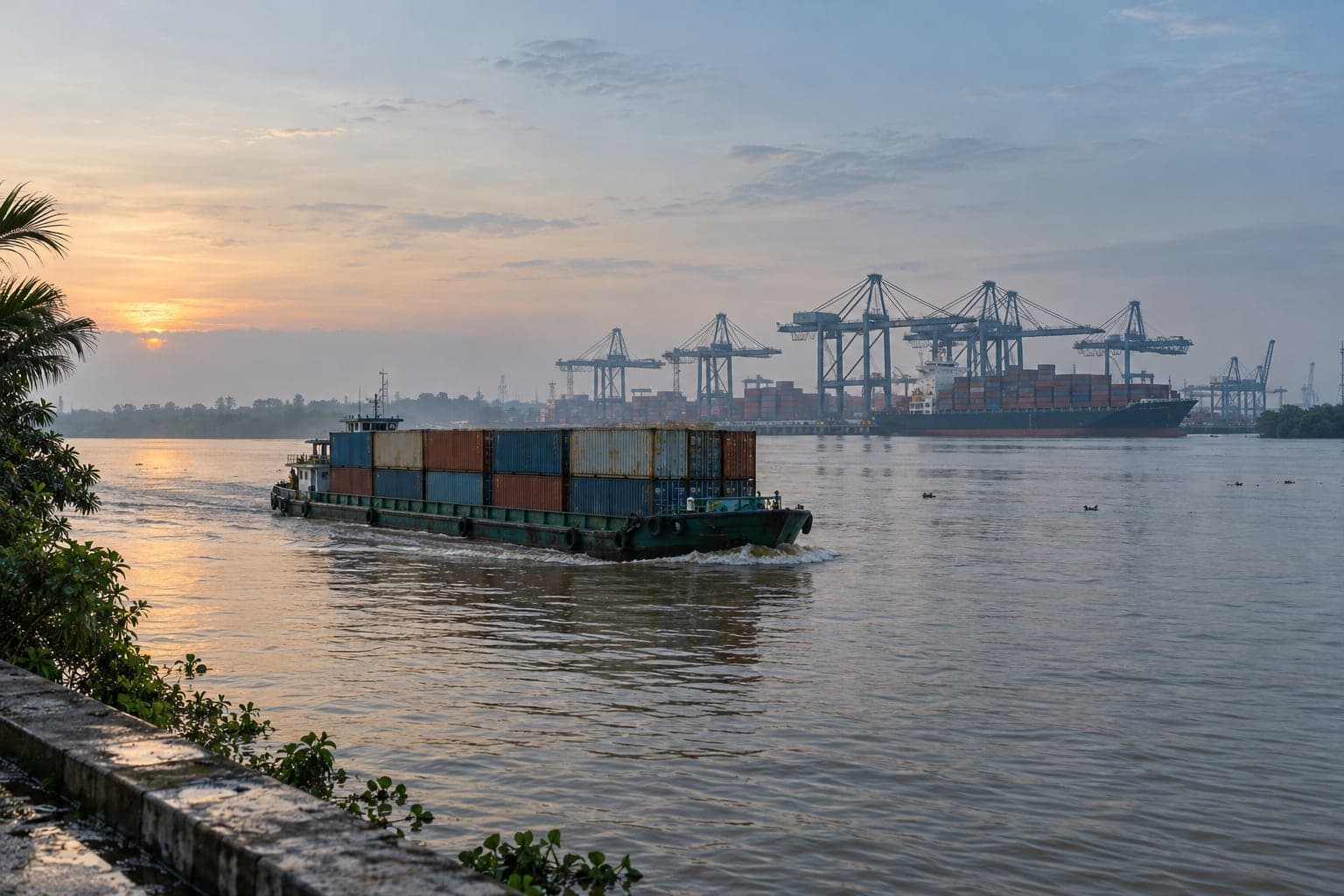
Every party in the chain has to share data on each shipment, said Cao Hong Phong, Deputy General Director of Gemalink International Port (Gemadept). He gave the example of a furniture maker exporting 10 containers to the US. The exporter would need to share three things: where to pick up the empty container, when the cargo will be ready to load onto a barge, and when the vessel leaves port. With those three times known in advance, waiting times shrink and emissions fall.
The snag is software. Truong Tan Loc, Chairman of the Board of Tan Cang - Cai Mep International Terminal (TCIT), said parties in the chain run different management systems, so their data does not connect.
What the Ministry of Industry and Trade proposes
Dr. Bui Ba Nghiem of the ministry's Import-Export Department said the priority is operational efficiency: fewer empty truck runs, shorter waits, less spoilage of farm produce in the cold chain. His proposals:
Review the procedures that stretch out inspection and customs clearance, corridor by corridor and cargo chain by cargo chain. Expand the National Single Window and the ASEAN Single Window, push electronic documents, and reform specialized inspection to speed up procedures.
On transport, make more use of waterways, coastal shipping and rail on suitable routes. Data from carriers, warehouses, manufacturers, ports and customers should be linked to consolidate cargo, cut empty runs and schedule deliveries.
The ministry proposes two pilots: a green logistics corridor with digital coordination linking production areas to Cai Mep-Thi Vai, and a Mekong Delta farm produce cold chain with digital monitoring and traceability. Each pilot must settle at the outset who coordinates locally, the cargo owners, logistics providers, port, technology and finance partners, baseline data, the implementing contact point and the review deadline.
Results would be measured by emissions, energy use, cost per unit of cargo, on-time delivery rate, empty-run rate and cargo loss rate. Nghiem added that results must be verified across the whole chain through cost, service quality and emissions reduction. The background report cites ISO 14083:2023 for measuring emissions. It also proposes that large cargo owners and logistics providers jointly draw up a transition roadmap and split the savings.
Decision 2229/QD-TTg of October 9, 2025 (the Logistics Services Development Strategy 2025-2035, vision to 2050) sets a target of 80% of logistics companies adopting digital transformation solutions by 2035.
What it means by sector
Furniture and containers via Cai Mep-Thi Vai. The 10-container furniture shipment to the US in Phong's example stands to gain if empty-container pickup, barge loading and vessel schedules are shared early. The pilot corridor linking production areas to Cai Mep-Thi Vai also targets this route. The sources give no savings figure for any shipment or cargo owner.
Mekong Delta farm produce. The pain point is spoilage in the cold chain. The proposal is to monitor temperature and power consumption in warehouses and cold chains to cut losses, and the loss rate is one of the pilot's metrics. The sources do not give the current loss rate. The bottlenecks for this cargo group are analyzed in our piece on farm produce logistics bottlenecks.
What cargo owners can do now
No rules apply yet, but a few steps can be taken immediately:
- Ask your forwarder for the three times on each shipment: empty container pickup, cargo ready for barge loading, vessel departure. These are the same three data points Phong named.
- Log waiting times at ports and warehouses and the number of empty truck runs on your shipments. If the pilots go ahead, this is the baseline for comparison and for negotiating a share of the savings.
- Follow the two pilots, the Cai Mep-Thi Vai corridor and the Mekong Delta cold chain, especially the list of participants and the review deadline once announced.
- Prepare electronic documents and get familiar with the National Single Window, since reform in this direction came up repeatedly.
For sea freight, ask for the three times at the quotation stage. Customers who need ocean freight with empty-container pickup and vessel schedules can send their trade lane to Homexim.
Sources
Related service: Ocean freight FCL/LCL