

Contents
To import medical devices into Vietnam, start with one question: is the device class A, B, C, or D. That risk classification decides the entire paper trail. Class A and B devices need a standard declaration, class C and D devices need a marketing authorization number from the Ministry of Health. Shipment value, brand, and origin change nothing here: a few thousand dollars of exam gloves and a multi-million dollar CT system walk two different legal paths because their risk classes differ, not because of the price tag.
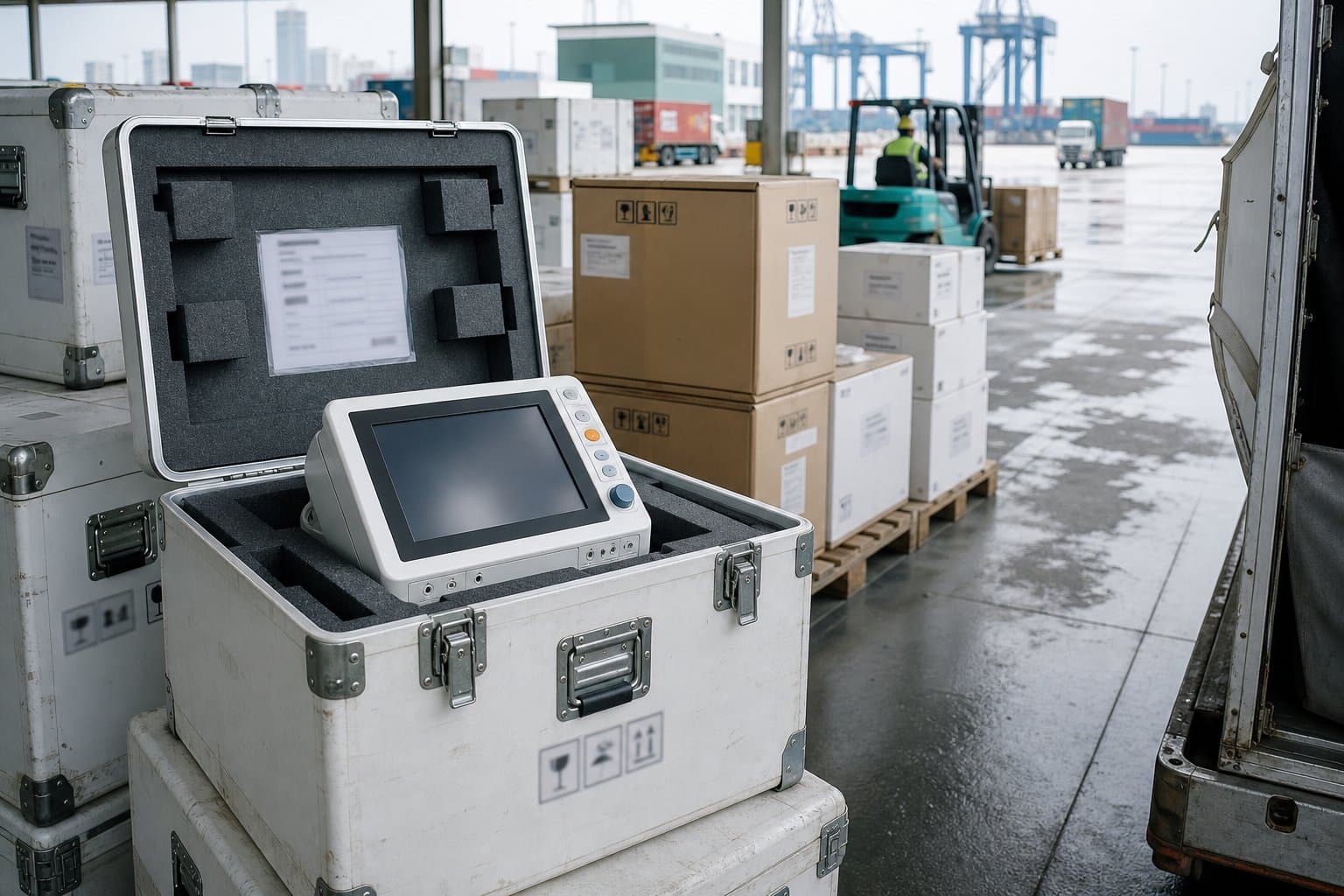
Forwarders see the same mistake on repeat: contract signed, vessel booked, and only when the cargo lands does anyone ask what papers the device needs. Medical devices sit under the Ministry of Health's specialized inspection regime, and a class C or D authorization is measured in months, not days, so working out of order means cargo sitting in the yard. This guide follows the order of a real shipment: classification, HS codes, taxes, the legal framework, the five-step process, the document set, and the most common errors.
The key point: A, B, C, D classification decides the paperwork
Every medical device imported into Vietnam must first be classified into one of four risk classes, A through D, under Decree 98/2021/ND-CP. Class A is the lowest risk, class D the highest. Dressings and basic examination instruments usually land in class A; personal blood pressure monitors in class B; ventilators and dialysis machines in class C; implants and coronary stents in class D. Classification is performed by a qualified classification body, and the result is published on the Ministry of Health's online portal.
The legal route follows from the class. Class A and B devices go through a declaration of applicable standards with the provincial health department, and the declaration number qualifies them for circulation. Class C and D devices must be registered with the Ministry of Health and can only be imported and sold once the marketing authorization number is issued. The paperwork of a medical device shipment follows its risk class, not its invoice value. Hold on to that rule and the rest of the procedure reads itself.
The paperwork of a medical device shipment follows its risk class, not its invoice value.
HS codes for medical devices: headings 9018 to 9022 and the wrong-chapter trap
Most medical device HS codes sit in chapter 90 of the tariff, concentrated in five headings:
- 9018: instruments and appliances for medical, surgical, and dental use, such as diagnostic ultrasound, ECG machines, endoscopes, syringes and needles.
- 9019: mechano-therapy appliances, medical massage apparatus, oxygen and aerosol therapy equipment.
- 9020: other breathing appliances and gas masks.
- 9021: orthopaedic appliances, artificial body parts, hearing aids, implanted devices.
- 9022: apparatus based on X-rays, including CT scanners.
The trap: not everything in a hospital belongs to chapter 90. Autoclaves classify under heading 8419 in the machinery chapter, hospital beds under 9402, operating-theatre lamps under 9405. Forcing the whole shipment into chapter 90 for convenience invites customs to reclassify, with the wrong duty and possibly a tax assessment behind it. The trap also works in reverse: a massage device sitting in heading 9019 is not automatically a medical device under Vietnam's medical device law.
The point most people miss: the HS code and the A, B, C, D class are two independent systems. The HS code drives the taxes, the risk class drives the health-sector paperwork. Neither can be inferred from the other, and a clean shipment has to be right on both.
Import duty and VAT on medical devices
A medical device shipment carries two main charges: import duty by HS code and value added tax. Import duty on many chapter 90 lines is low, with some lines at 0%, but the exact rate must be checked against the tariff in force for the precise HS code when the declaration is filed, alongside the special preferential schedule where a valid C/O from an FTA partner exists.
On VAT, the new Law on Value Added Tax No. 48/2024/QH15 took effect on July 1, 2025: medical devices as defined by Vietnam's medical device regulations fall in the 5% bracket, with details in Decree 181/2025/ND-CP. The load-bearing word is the condition: the goods must prove their status as medical devices through the classification result, the declaration number, or the marketing authorization number. Fail to prove it and the standard 10% applies, and 5% of the value of a full shipment is not small money. It is also why customs now reads classification files more carefully: the preferential rate is tied to the legal identity of the goods. Confirm the applicable rate under the tax policy in force when the declaration is filed.
The legal framework for importing medical devices
The legal framework for this cargo fits into four groups of instruments:
- Decree 98/2021/ND-CP: the backbone of the regime, governing A, B, C, D classification, standard declarations, marketing authorization, and the cases that still require an import license.
- Decree 07/2023/ND-CP and Decree 04/2025/ND-CP: amendments to Decree 98/2021, handling the transition deadlines for legacy licenses and registration numbers, shifting from pre-market to post-market control, and requiring customs to cross-check classification data on the Ministry of Health portal.
- The Ministry of Health circulars on classification rules and device schedules: the technical basis for assigning a device to class A, B, C, or D.
- The Law on VAT 48/2024/QH15 with Decree 181/2025/ND-CP, plus the import-export tariff in force: the basis for computing import duty and VAT by HS code.
One transition point worth knowing: the import licenses issued between 2018 and 2021, extended several times, have now expired in sequence. The standard route today is the declaration number for class A and B and the marketing authorization number for class C and D. Import licenses remain only for special cases such as research, aid, and humanitarian medical work. A shipment relying on a legacy license from previous years is likely to be stopped at the border.
The five steps to import medical devices into Vietnam
A real medical device shipment runs through five steps, and the first two must be complete before the cargo is loaded:
- Classify the device through a qualified classification body; the classification result anchors every document that follows.
- File the declaration of applicable standards for class A and B devices with the provincial health department, or register class C and D devices with the Ministry of Health for a marketing authorization number.
- Transmit the electronic customs declaration through ECUS/VNACCS when the cargo arrives, entering the correct HS code and the declaration or authorization number, then wait for the risk channel and pay the taxes.
- Cross-check at clearance: customs verifies the classification data and the authorization number declared by the importer against the Ministry of Health portal, and releases the goods when they match.
- Post-clearance control: keep the classification file, the authorization file, labels, and technical documents ready for audits by both the health authorities and customs.
On timing: the class A and B declaration is filed online and a clean file gets its number quickly. A class C or D authorization is a different story: the review is measured in months, and a missing original such as the CFS or the ISO 13485 certificate sends the file back to the start. The rule Homexim holds for clients is simple: no authorization number, no loading, unless the owner accepts the waiting cost in advance.
The document set
The file for a medical device shipment has two layers: the health-sector documents proving the goods may circulate, and the commercial document set for clearance:
- The medical device classification result: the root of the whole file, fixing the device in class A, B, C, or D.
- The declaration number for class A and B, or the marketing authorization number for class C and D; an import license where the shipment falls into a special case.
- CFS, the certificate of free sale from the country of origin: mandatory in the registration dossier.
- The manufacturer's ISO 13485 certificate, evidencing the quality management system for medical devices.
- The device owner's letter of authorization for the entity filing the declaration or registration in Vietnam.
- Commercial documents: the contract, commercial invoice, packing list, B/L or AWB, and a C/O where special preferential duty is claimed.
Mind the division of labor between the layers. The CFS, the ISO 13485 certificate, and the letter of authorization serve the declaration and registration stage, which means they must exist before the goods leave the factory. At the port, customs mainly cross-checks the numbers and the classification result. Chasing a CFS from the manufacturer abroad after the cargo has landed is the slowest possible scenario, because only the device owner can obtain it.
Common errors and one real case
The three errors below account for most of the medical device shipments Homexim has cleared after they got stuck at the port:
- Classifying one level too low: filing a device as class A or B to keep the dossier light when its nature is class C or D. Once the wrong classification surfaces, the declaration number loses effect and the file restarts on the registration route, measured in months.
- Importing before the authorization number exists: the contract is signed and the cargo loaded while the class C or D dossier is still under review. The goods arrive first, the number arrives later, and the gap is billed in daily container and yard charges.
- Confusing medical devices with household goods: massage devices, heat belts, and nebulizers are the classic gray zone. Declared as household goods while the catalog and label advertise therapeutic effects, the shipment gives customs every right to stop it and demand proof of what it is.
A typical scenario at Cat Lai: a shipment of handheld massage devices declared as household goods, commercial documents clean, but the manufacturer's invoice and catalog carried the words therapy device. Customs held the release and asked for proof that the goods were not medical devices. The importer had to obtain a classification result confirming the product fell outside the regime, plus a written explanation. The bill: four working days, over ten million dong in container and yard charges on two containers, and a late delivery to the supermarket chain waiting behind it. The cheapest lesson from that case: screen the wording on the invoice, catalog, and label at the ordering stage, and never let one word like therapy decide the fate of a shipment.
Medical devices are not hard cargo to clear, but they punish anyone who works the steps out of order: classification before the contract, the authorization number before the vessel. Homexim checks the risk class and the status of the declaration or authorization number for each HS code before loading, computes both taxes against the tariff in force, and gets your devices to the warehouse on schedule instead of leaving them at the port waiting for paper.
Related service: Customs brokerage