

Contents
Importing steel into Vietnam now runs through two control gates at once: state quality inspection under national technical regulations, and trade remedies, meaning anti-dumping and anti-circumvention duties applied by origin. The first gate decides whether the cargo can be released and used. The second decides the landed cost, and it does not show up when you only check the regular import tariff.
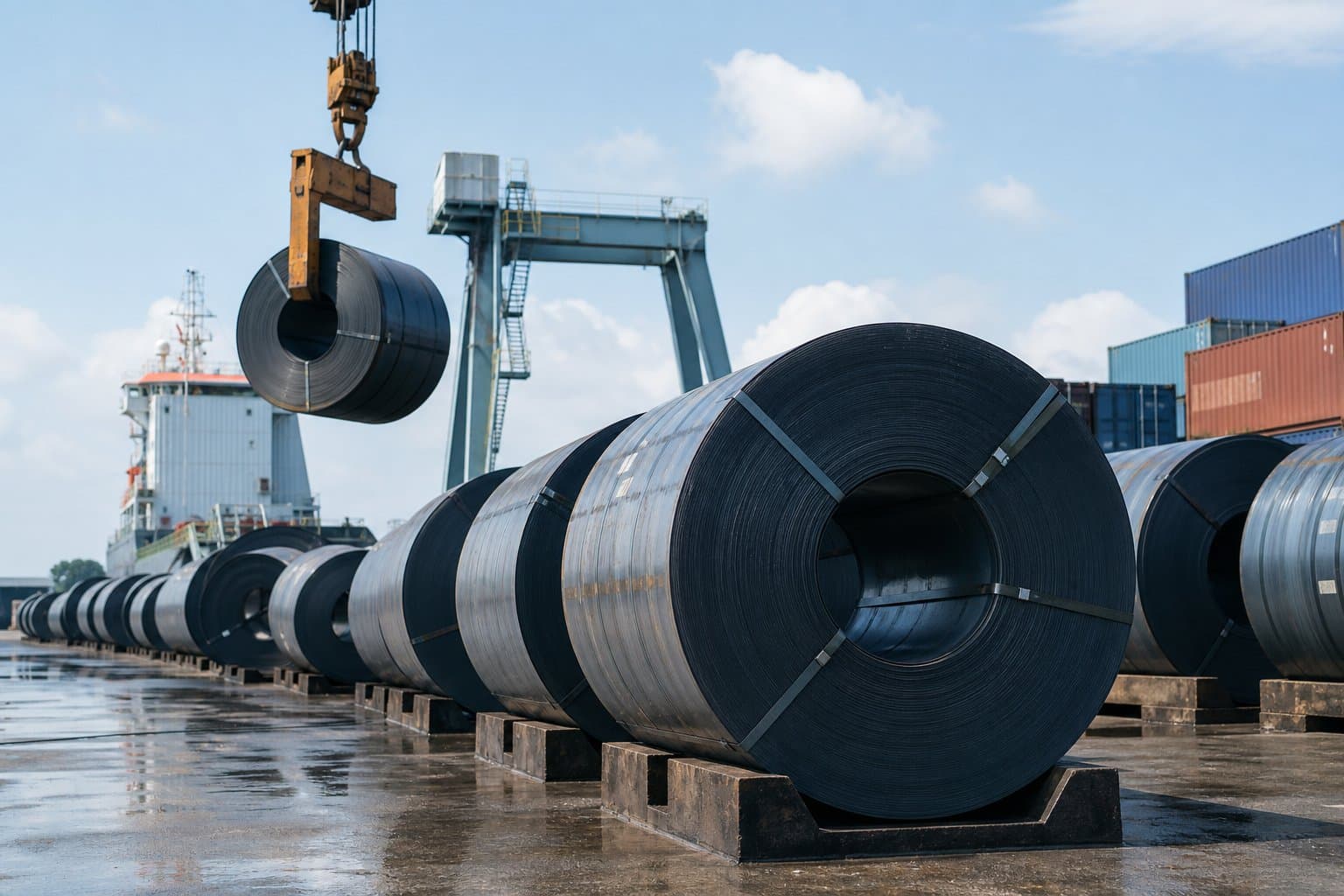
Steel is also the most heavily defended product group in Vietnam's import tariff today. Between late 2024 and early 2026 alone, the Ministry of Industry and Trade imposed new duties on hot-rolled coil and galvanized steel and extended the measure on color-coated sheet. This guide covers the chapter 72 HS codes, the three layers of duty, the legal instruments in force, the five-step process, the document set, and the mistakes a forwarder sees repeatedly on this cargo.
The key point: two parallel control gates
Steel is not hard at the paperwork level. The difficulty is that two regulatory regimes run in parallel and neither substitutes for the other. Quality inspection answers whether the steel meets the technical regulation for use. Trade remedies answer how many extra percentage points this shipment, from this country, made by this mill, must carry. Clear the first gate and skip the second, and the goods will still be released; the landed cost simply will not be the one in the contract.
The gap is anything but small. Galvanized steel of Chinese origin currently carries anti-dumping duty of up to 37.13%, Chinese hot-rolled coil up to 27.83%, and the rates apply per producer rather than flat per country. Checking trade remedies before signing the contract is therefore the cheapest step of the whole import: a few minutes of lookup against a duty that can equal the entire margin of the deal.
Galvanized steel of Chinese origin carries anti-dumping duty of up to 37.13%. Checking trade remedies before signing is the cheapest step of the whole steel import.
HS codes for steel: a quick map of chapter 72
Iron and steel sit in chapter 72, grouped by product form and degree of processing. A quick map for the common commercial lines:
- 72.08: hot-rolled flat products in coils or sheets, not coated (HRC). This is the group currently under anti-dumping duty for Chinese origin.
- 72.09: cold-rolled flat products (CRC), further processed from hot-rolled, with a finer surface.
- 72.10: flat products that are plated, coated, or clad: galvanized sheet, aluminum-zinc coated sheet, color-coated sheet. The group carrying the most trade remedies today.
- 72.13 to 72.15: bars and wire rod, used for concrete reinforcement and wire drawing.
- 72.16: H, I, U, and V structural sections for steel-frame buildings.
- 72.24 to 72.28: alloy steel in bars, wire, and coils, classified by alloy content.
One exception that gets misfiled often: steel pipe is not in chapter 72. Seamless and welded pipe belongs to chapter 73, headings 73.04 to 73.06, and the product policy follows that chapter.
The line that deserves the most care is alloy versus non-alloy. A trace of boron or chromium above the threshold moves the code into the alloy group, with a different duty and a different policy. That used to be a popular workaround, so customs watches this group closely: the declared code must follow the chemical composition in the mill test certificate of the actual shipment, not the trade name on the contract.
Three layers of duty: why the C/O sets your landed cost
A steel shipment into Vietnam carries three layers of duty, stacked in order:
- Import duty: check the tariff in force against the exact HS code when the declaration is filed. A valid C/O from a country with a free trade agreement with Vietnam brings the special preferential rate, usually well below the standard one.
- Trade remedy duty: anti-dumping and anti-circumvention, applied by origin and by the individual producer named in the ministry's decision. This layer does not appear in the regular tariff, which is why it is the one most often missed.
- Value added tax: the standard rate is currently 10%, charged on the value that already includes import duty and any trade remedy duty; confirm the applicable rate under the VAT policy in force at filing.
The C/O therefore plays two roles at once. The first is cutting the import duty layer: form E for China, form D for ASEAN, AK and AJ for the Korea and Japan lanes. The second is heavier: the C/O is the origin evidence that decides whether the shipment falls under an anti-dumping measure at all. The same hot-rolled coil carries up to 27.83% extra if it is Chinese origin, and nothing extra if it comes from a country not under investigation.
There is one more tier that buyers rarely notice: within each duty decision, every producer has its own rate. Mills that cooperated with the investigation earn a lower individual rate, while unnamed mills take the highest residual rate. Two shipments of galvanized steel, both from China, can differ by ten percentage points of duty purely because of the mill. Asking for the producer's name and checking it against the list in the decision belongs before the signature, not after arrival.
The legal framework for importing steel into Vietnam
The legal framework for this cargo fits into three groups: quality regulations, customs procedure, and the trade remedy decisions currently in force:
- QCVN 7:2019/BKHCN: the national technical regulation on steel for concrete reinforcement, the basis for quality inspection and conformity certification of that group.
- QCVN 20:2019/BKHCN: the national technical regulation on stainless steel.
- Circular 38/2015/TT-BTC, as amended by Circular 39/2018/TT-BTC: customs procedure, declaration dossiers, and post-filing amendments.
- Decision 1959/QD-BCT of 2025: definitive anti-dumping duty on Chinese hot-rolled coil, from 23.1% to 27.83%, applied for five years.
- Decision 612/QD-BCT of 2026: provisional duty of 27.83% on wide-width hot-rolled coil from 1,880 mm to 2,300 mm imported from China, closing the wide-width circumvention route. It is provisional, so watch for the final determination.
- Decision 2310/QD-BCT of 2025: definitive anti-dumping duty on galvanized steel, up to 37.13% for Chinese origin and 15.67% for Korean origin, applied for five years.
- Decision 2822/QD-BCT of 2024: a five-year extension of the anti-dumping duty on color-coated steel from China and Korea, through October 2029.
Beyond these, Chinese H-section steel also remains under duty following its review. And the list does not stand still: new measures open, old ones get reviewed, and individual mill rates shift with each annual review. Before every contract, the mandatory step is to check the measures in force on the portal of the Trade Remedies Authority of Vietnam under the Ministry of Industry and Trade, against the exact HS code and country of origin, rather than trusting any static article, including this one.
The five steps to import steel into Vietnam
A standard steel shipment runs through five steps, and the first one sits before the contract is even signed:
- Classify the HS code by composition and product form, then check trade remedy measures by code and origin before signing. Ask for the producing mill's name to find the individual rate that applies to it.
- Register the state quality inspection at the Standards, Metrology and Quality office of the province where the declaration will be filed, for grades covered by a technical regulation such as reinforcing steel and stainless steel.
- Transmit the customs declaration through ECUS/VNACCS, include the duty code for anti-dumping where the goods are in scope, pay the duties, and wait for the risk channel.
- Take samples on arrival and send them to a designated testing organization for the conformity certificate.
- Clear the goods, haul them to the warehouse, and file the test results with the inspection agency within the registered deadline.
On timing: the inspection registration can be confirmed within the day if the file is clean, and test results take from a few days to a week depending on the grade and the laboratory. For steel inspected after clearance, the cargo may move to the warehouse for storage while results are pending, but it cannot be used or sold until the conformity certificate is issued.
On the trade remedy side, one technical point matters: anti-dumping duty is declared directly on the customs declaration under its own duty code. Omitting it is not an escape; customs matches the HS code against the measure list, reassesses the duty, and adds late-payment interest plus a penalty for misdeclaration. The reassessment reaches back after clearance, so a released declaration is not a closed case.
The document set
The file for a steel shipment is built around one central document, the mill test certificate. Beyond the familiar commercial document set, it needs:
- Mill test certificate: chemical composition, mechanical properties, steel grade, production standard, and the mill's name. This is the basis for HS classification and the origin cross-check.
- C/O: sets the preferential import duty and serves as the origin evidence when trade remedies are examined.
- The confirmed quality inspection registration from the provincial office, for grades covered by a technical regulation.
- Commercial invoice, packing list, and the foreign trade contract: the basis of the dutiable value.
- B/L: the ocean bill of lading, whose shipper and port of loading must match the C/O.
Within this set, the mill test certificate deserves the closest read. The mill named on it must match the producer on the C/O and the mill list in the duty decision. When the three sources disagree, customs is entitled to suspect origin circumvention and demand proof of the production chain, and the cargo sits in the yard while the explanation is prepared.
Common mistakes, and one real case
The three mistakes below account for most of the trouble on steel shipments Homexim has handled:
- Not checking trade remedies before fixing the price: Chinese offers usually look far cheaper, but the advantage disappears once anti-dumping duty is added. Committing to a resale price before checking the duty locks the buyer into a losing deal.
- Declared origin that contradicts the mill test certificate: buying through a trader, the C/O names one country while the mill cert reveals a mill in a country under duty. Customs rejects the preference, applies the highest residual anti-dumping rate, and may refer the file for a post-clearance audit.
- Confusing alloy and non-alloy steel: declaring by trade name instead of the actual composition in the mill cert. A wrong code drags in the wrong duty and the wrong remedy scope, and the difference comes back as a reassessment with penalties.
A typical scenario: a client imported four containers of galvanized steel coil from China into Hai Phong, about 100 tons, and only passed the documents to Homexim after the contract was signed. Checking Decision 2310 revealed that the producing mill was not on the list of individual rates, so the shipment fell under the residual rate of 37.13%. The anti-dumping duty alone came to nearly VND 800 million on a shipment worth just over VND 2 billion, and the client's pricing had never included it. With the cargo already on the water there was no renegotiating; the only option left was to pay the duty in full and pull the containers on time, before storage charges piled onto an already thin deal. Every dong of that damage was avoidable with one lookup before signing.
Steel is a cargo where a single ministry decision can rewrite the economics of a deal. Homexim checks the HS code and the trade remedy measures before the client signs, handles the inspection registration and the customs declaration, and follows the shipment until the conformity results are filed, so the landed cost of your steel matches the one you planned.
Related service: Customs brokerage